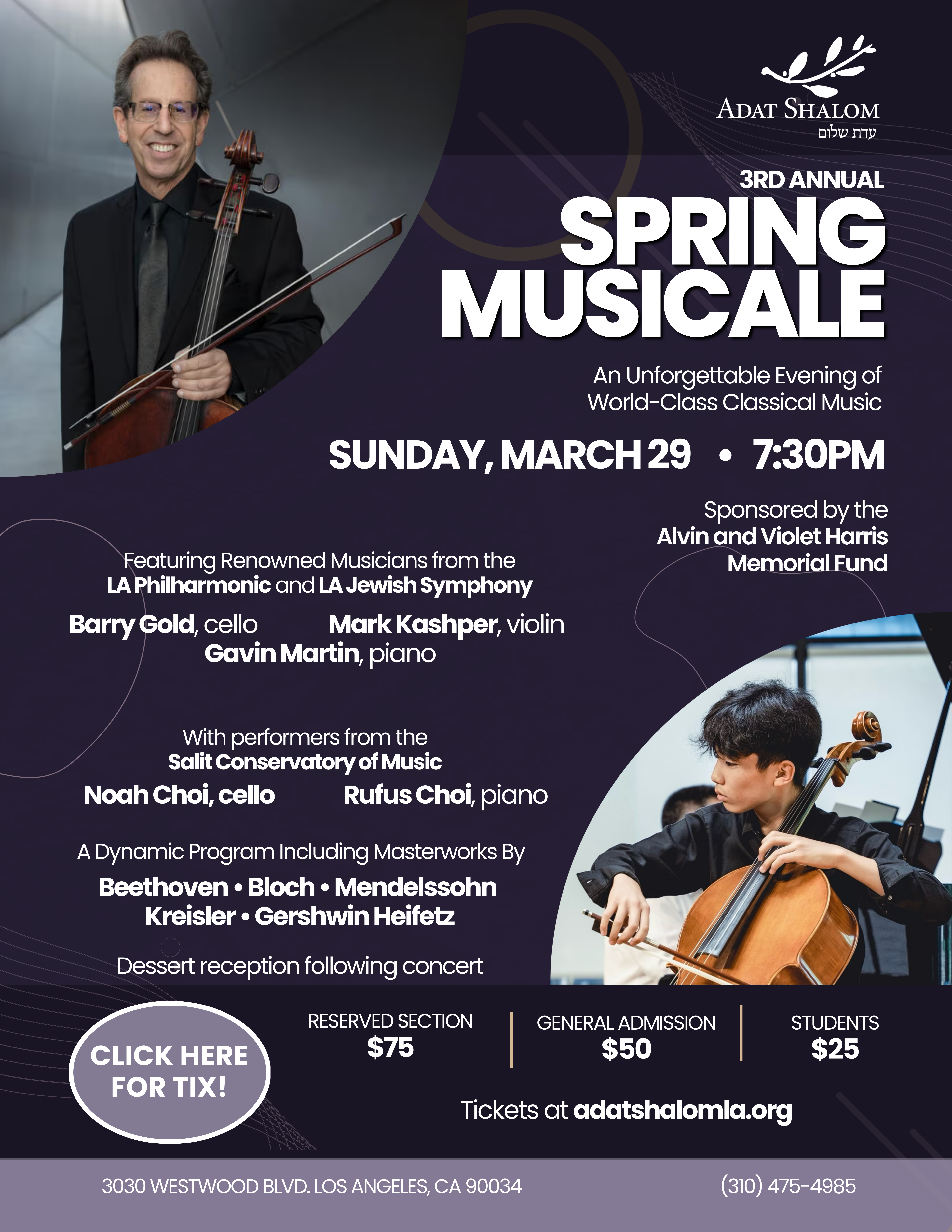

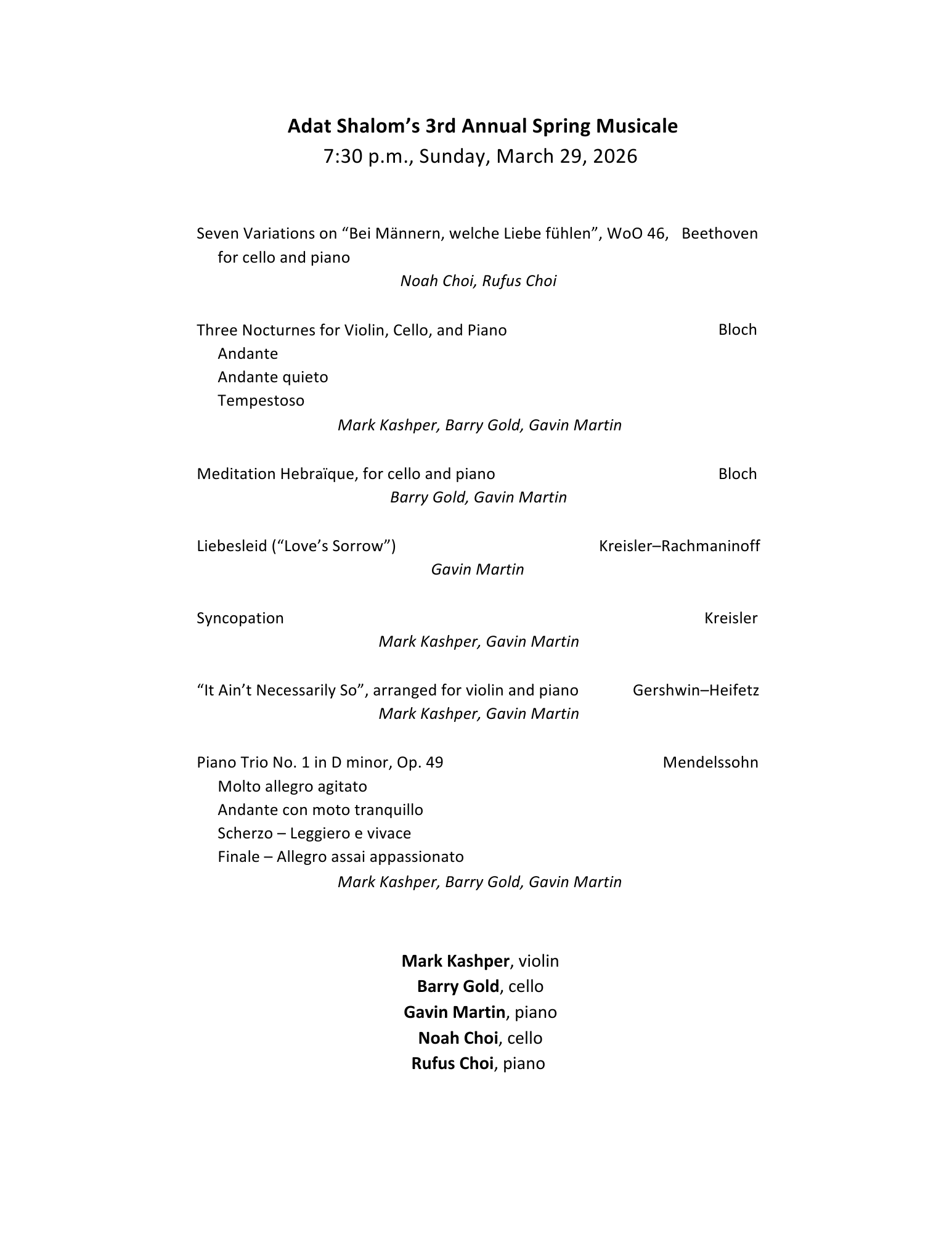
Seven Variations on “Bei Männern, welche Liebe fühlen”. –– Ludwig van Beethoven (1770–1827) was a master at composing variations on a theme. Here in this early work he adapted “Bei Männern”, the famous duet from Mozart’s Die Zauberflöte (“The Magic Flute”). The duet’s lyrics tell us that men who feel the call of love with a good heart reach a divine state when that love is shared with a devoted partner. “We rejoice in love and live by love alone.”
Three Nocturnes for Violin, Cello, and Piano. –– Ernest Bloch (1880–1959) was Swiss-American and one of the most important Jewish composers of the first half of the 20th century. Violin was Bloch’s instrument, and he composed numerous chamber works of exceptional quality, especially for strings and piano, and several large-scale orchestral works of which the best known are Schelomo and Voice in the Wilderness for cello and orchestra, Baal Shem, Poems of the Sea, Suite Hebraïque for viola and orchestra, and Avodat Hakodesh for cantor, choir, and orchestra that remains a pinnacle of Jewish liturgical music. Three Nocturnes dates from 1924 and is a good example of Bloch’s creativity. The first piece is impressionistic in Bloch’s unique harmonic language. The second is a lullaby of great beauty. The third is an unexpected surge of muscularity, at times jazzy and impassioned, with subtle throwbacks to the first two pieces, ending quietly. Together they are a window on the Bloch genius.
Meditation Hebraïque. –– Bloch composed some of the most beautiful music in the cello repertoire. His best known piece “Prayer”, a part of From Jewish Life, is immortal. Another celebrated work is the Meditation Hebraïque, from 1924, the same year as the Three Nocturnes and From Jewish Life. Amid its drama it remains darkly sombre. A wandering line takes unexpected turns, and the melodic interval of the augmented second, so strongly associated with Ashkenazic Jewish music, is ever present. Consider closing your eyes and letting this music sink in.
Liebesleid. –– Fritz Kreisler (1875–1962) was born in Vienna of a Jewish father and Protestant mother and was baptized at age 12. He was a highly accomplished violinist, pianist, and composer. Liebesleid (“Love’s Sorrow”) and Liebesfreud (“Love’s Joy”) are two of three pieces Kreisler composed for violin and piano in 1905 as Alt-Wiener Tanzweisen (“Old Viennese Dances”). They are very popular and immediately recognizable. Both have been transcribed for various combinations of instruments: the technically demanding piano transcriptions of Sergei Rachmaninoff (1873–1943) are well known and part of the standard repertoire.
Syncopation. –– Kreisler had his New York debut at age 13 in 1888 and had various prolonged residences in the United States, Austria, Germany, and France until becoming a naturalized American citizen in 1943. Syncopation was composed in 1911 and is a charming, salon-style work with lilting, refreshing rhythms. The listener will appreciate its Joplinesque character, and while it is unclear whether the two composers ever met, there can be little doubt Kreisler was aware of Scott Joplin (1868–1917), the “king of ragtime.” Kreisler has a star on the Hollywood Walk of Fame at 6655 Hollywood Blvd. in recognition of his recording career.
“It Ain’t Necessarily So”. –– The life and compositions of George Gershwin (1898–1937), and his tragic end from a brain tumor, are so well known as to require little comment. His impact on compositional style internationally was enormous. In his formative years, Gershwin sought instruction and collaboration from composition teacher Nadia Boulanger and composer Maurice Ravel in France who both refused, wisely recognizing Gershwin’s unique genius and fearful of influencing it negatively. “It Ain’t Necessarily So” derives from Gershwin’s 1935 opera Porgy and Bess, long an American cultural icon, based on the 1925 novel Porgy by DuBose Heyward. “Summertime” is its best-known song; also memorable are “It Ain’t Necessarily So”, “I Loves You, Porgy”, and “I Got Plenty o’ Nuttin’”. Jascha Heifetz (1901–1987), of Lithuanian-Jewish origin and one of the greatest violinists of all time, composed this dazzling, virtuosic transcription of “It Ain’t Necessarily So” in the early 1940s. When Fritz Kreisler heard the 12-year-old Heifetz perform the Mendelssohn Violin Concerto, he declared, “We may as well break our fiddles across our knees.”
Piano Trio No. 1 in D minor. –– Felix Mendelssohn (1809–1847) was perhaps the greatest musical prodigy ever, both as pianist and composer. His Overture to A Midsummer Night’s Dream at age 17 is widely regarded the greatest piece of music ever composed by a teenager. Mendelssohn’s grandfather was the great Jewish philosopher Moses Mendelssohn, but Felix’s father Abraham renounced Judaism, and Felix was raised secularly and baptized at age 7. He was nevertheless always proud of his Jewish roots. Prevailing European antisemitism, however, particularly Richard Wagner’s attacks cloaked as musical criticism, severely harmed Mendelssohn’s reputation after his death. Under Hitler his music was banned altogether. Only in the last 80 years has his music well-deservedly resurfaced. Mendelssohn composed orchestral and chamber works, vocal pieces, and piano music. His Romantic compositional tastes were more conservative than contemporaries including Chopin, Schumann, and Liszt, but the music was always well constructed. The Piano Trio No. 1 in D minor (1839) is one of Mendelsohn’s most popular chamber works, perhaps second only to the monumental Octet in E-flat major, Op. 20 (1825, composed at age 16!). The D minor Trio prompted Schumann to declare Mendelssohn the “most brilliant” of modern composers. The four movements adhere closely to traditional forms: sonata-allegro, song (ternary), scherzo-trio, and sonata-rondo. The final movement is herculean.
Notes prepared by Michael Rosove